
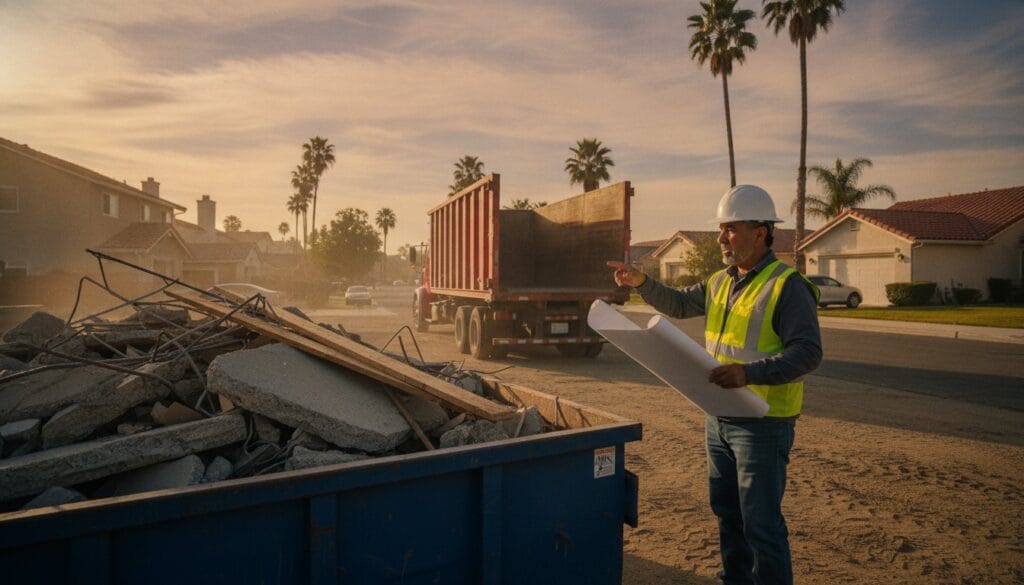
The wrong dumpster doesn’t just slow down your crew; it quietly eats your profit margin one overage fee at a time. If you’ve ever watched a project budget unravel because a standard roll-off couldn’t handle a load of concrete or demo debris, you already know exactly what’s at stake. Dumpster rental for contractors in Los Angeles comes with a unique set of pressures: tight urban job sites, strict city waste diversion requirements, and delivery windows that can make or break your schedule.
You’re right to take this seriously. LA isn’t a forgiving market for waste management mistakes, and most general guides don’t account for the weight-intensive reality of demolition and heavy construction work across the city and San Fernando Valley.
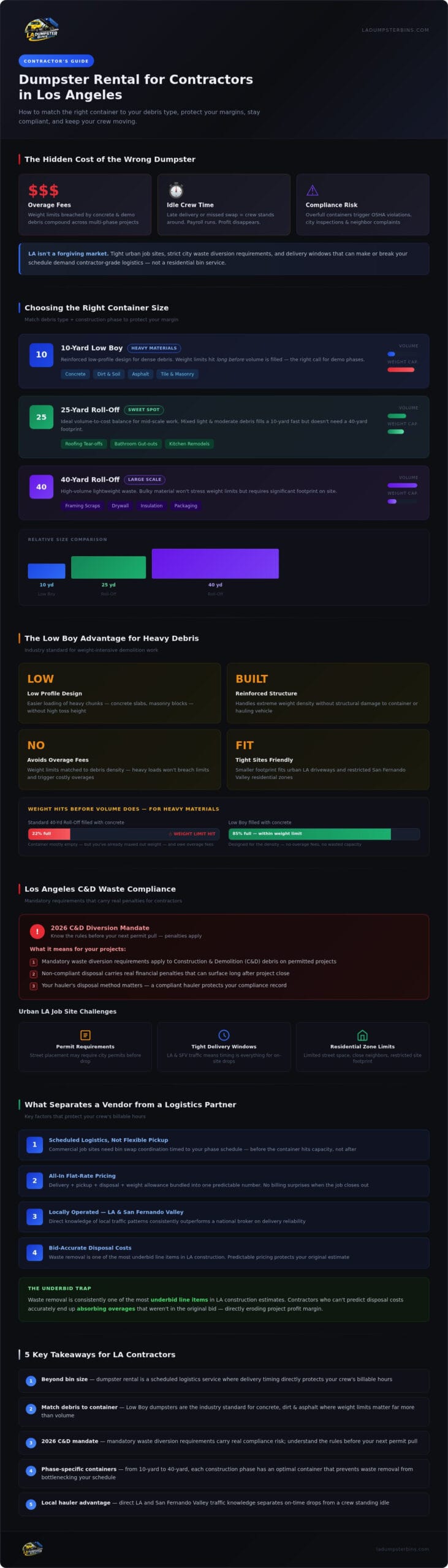
This guide is built specifically for working contractors. You’ll learn how to match your debris type to the right container, from 10-yard roll-offs to specialized Low Boy dumpsters designed for heavy materials like dirt and concrete, so you can protect your margins, stay compliant with local C&D recycling mandates, and keep your crew moving without costly delays.
Key Takeaways
- The right dumpster rental for contractors in Los Angeles goes beyond bin size — it’s a scheduled logistics service where delivery timing directly protects your crew’s billable hours.
- Matching your container to your debris type is critical: Low Boy dumpsters are the industry standard for heavy materials like concrete, dirt, and asphalt, where weight limits matter far more than volume.
- Los Angeles contractors face mandatory C&D waste diversion requirements that carry real compliance risk — understanding the 2026 rules before your next permit pull can save you costly penalties.
- Choosing between a 10-yard and a 40-yard roll-off isn’t just about project scale — each construction phase has a container that keeps waste removal from bottlenecking your schedule.
- A locally operated hauler with direct knowledge of LA and San Fernando Valley traffic patterns can mean the difference between an on-time drop and a crew standing idle.
Why Reliable Dumpster Logistics Drive Contractor Profitability in Los Angeles
Most rental companies hand you a bin and walk away. That’s not how commercial job sites work. Contractor-grade dumpster rental for contractors in Los Angeles is a scheduled logistics service, one where delivery timing, container placement, and bin swap coordination directly affect how many billable hours your crew produces each day. Get that wrong, and you’re not just dealing with an inconvenience; you’re watching your margin shrink in real time.
The math is straightforward. A skilled demolition crew in Los Angeles costs real money per hour. If a late delivery or missed swap means that crew is standing around waiting for a container to clear, that idle time doesn’t disappear from your payroll. It disappears from your profit. Residential-focused rental companies often don’t account for this reality. They’re built around flexible pickup windows and homeowner schedules, not the tight sequencing that commercial job sites demand.
The Impact of Waste Management on Job Timelines
Debris accumulation is a schedule problem before it’s a safety problem. In tight San Fernando Valley residential zones, where street space is limited and neighbors are close, an overfull container creates immediate friction: restricted crew movement, potential OSHA site safety violations, and the kind of neighbor complaints that invite city inspections at the worst possible moment. Coordinating bin swaps before a container hits capacity, not after, is what keeps demolition crews moving without interruption. Understanding the full scope of construction waste management makes clear why proactive logistics planning matters far more than reactive pickup calls.
Cost Control and Bid Accuracy
Waste removal is one of the most underbid line items in LA construction. Contractors who can’t predict their disposal costs accurately end up absorbing overages that weren’t in the original estimate. The overage trap is real: standard roll-offs carry weight limits, and heavy demolition debris like concrete, tile, and soil can breach those limits fast, triggering fees that compound across a multi-phase project.
This is why experienced contractors increasingly rely on all-in pricing, a flat-rate rental structure that bundles delivery, pickup, disposal, and weight allowances into a single, predictable number so there are no billing surprises when the job closes out.
Choosing the right hauler matters just as much as choosing the right container. A locally operated company with direct knowledge of LA and San Fernando Valley traffic patterns will consistently outperform a national broker on delivery reliability. That local edge is what separates a vendor from a genuine logistics partner on dumpster rental for contractors in Los Angeles.
Choosing the Right Bin Size for Your Job Site: From 10 to 40 Yards
Bin size is where most contractors either protect their margin or quietly lose it. Too small, and you’re paying for extra swaps. Too large, and you’re renting cubic yards you’ll never fill. The right container isn’t just about project scale; it’s about matching your debris type and construction phase to a bin that works with your site, not against it.
Here’s a practical breakdown of the three core options available for dumpster rental for contractors in Los Angeles:
- 10-Yard Low Boy: Built for heavy materials. Concrete, dirt, asphalt, tile, and masonry loads hit weight limits long before they fill a standard roll-off. The Low Boy’s lower profile and reinforced design handle that density without triggering costly overages. It’s the right call for demo phases where your debris is heavy but not voluminous.
- 25-Yard Roll-Off: The sweet spot for mid-scale work. Roofing tear-offs, bathroom gut-outs, and full kitchen remodels generate a mix of light and moderately heavy debris that fills a 10-yard fast but doesn’t justify a 40-yard footprint. The 25-yard hits the volume-to-cost balance most remodeling contractors need.
- 40-Yard Roll-Off: Designed for large-scale commercial debris and bulky lightweight waste. Framing scraps, drywall, packaging, and insulation take up significant volume without stressing weight limits. On major commercial builds or new construction projects, a 40-yard keeps your site clear through extended phases without requiring constant swaps.
Sizing Guide by Project Type
Kitchen and bath remodels in West LA typically generate a manageable but dense debris mix: cabinetry, tile, drywall, and plumbing fixtures. A 25-yard roll-off handles most of these jobs cleanly. For roofing projects, shingle weight is the variable that trips up contractors who default to volume-based sizing; a full tear-off can breach weight limits in a standard bin before it looks full. Roofing jobs often call for a Low Boy or a carefully staged 25-yard pull. Full-scale new construction is where the 40-yard earns its place, specifically during framing and interior rough-in phases where bulky, lightweight waste accumulates fast. Reviewing California construction and demolition debris regulations before your project starts will also clarify what materials require separate diversion, which affects how you stage your containers from the start.
Space Constraints on Urban Job Sites
A 40-yard roll-off typically runs around 22 feet long. That’s a non-starter on many narrow San Fernando Valley driveways or gated West LA properties. Always measure your drop zone before booking. Overhead clearance matters too: low-hanging power lines and mature trees can block delivery trucks entirely. If your container needs to sit on a public street rather than private property, Los Angeles requires an encroachment permit from the city’s Bureau of Street Services before placement. Your hauler should walk you through that process, but confirming it upfront keeps your delivery on schedule.
Matching the right bin to your job phase is one of the simplest ways to control costs on any build. If you’re unsure which container fits your next project, get a free estimate from a local LA hauler who knows the difference between a demo load and a framing load before the truck rolls.
Managing Heavy Debris: The Technical Role of Low Boy Dumpsters
Volume and weight are not the same thing. That distinction is where most contractors run into trouble. A standard 40-yard roll-off looks enormous on your job site, but its weight capacity is fixed regardless of how much cubic space remains. Load it with concrete, asphalt, or compacted soil, and you’ll breach the weight limit long before the bin looks full. The result: overweight fees, potential DOT violations, and a truck that legally cannot leave your site until the load is reduced.
This is exactly what Low Boy dumpsters are engineered to solve. Their lower center of gravity, reinforced floor construction, and reduced profile are purpose-built for dense, heavy materials that would overload a standard roll-off at a fraction of its visual capacity. For dumpster rental for contractors in Los Angeles handling demolition-heavy work, a Low Boy isn’t an upgrade; it’s the correct tool for the job.
The materials that belong in a Low Boy are specific: clean concrete, asphalt, dirt, sand, and gravel. These are high-density loads where weight accumulates fast. The EPA construction and demolition waste guidelines make clear that proper material separation at the source isn’t just an environmental best practice; it’s a disposal cost strategy. Clean, source-separated heavy materials qualify for lower-cost processing at recycling facilities. Mix in wood scraps, drywall, or general trash, and that load gets reclassified as mixed C&D waste, which carries higher tipping fees across LA County facilities.
Concrete and Asphalt Disposal
Not all concrete hauls are equal. Clean concrete, meaning slabs and footings with no embedded rebar, processes cleanly at recycling facilities and costs less to dispose of. Reinforced concrete with rebar requires sorting before it can be recycled, which adds time and cost. If your demo phase involves structural concrete, confirm with your hauler upfront whether the load is classified as clean or mixed; it affects your disposal rate directly.
For San Fernando Valley driveway contractors pulling asphalt, staging matters. A typical LA heavy haul is rated to a 10-ton weight limit per load, so larger asphalt removal jobs require sequenced pulls rather than a single overloaded bin. Plan your Low Boy swaps around that ceiling, not around how full the container looks.
Dirt and Soil Management
Excavation jobs generate more weight than most contractors budget for, especially after rain. Moisture content can significantly increase soil weight per cubic yard, which compresses how much you can legally haul per pull. The number of Low Boys your excavation requires depends on your soil type and moisture conditions, not just the volume of earth you’re moving.
Keep clean dirt loads uncontaminated. Mixing soil with concrete chunks, vegetation, or construction debris strips it of its “clean fill” classification. Once contaminated, disposal costs rise and some facilities won’t accept the load at all. Separate your materials from the first shovel; retrofitting a contaminated load on-site wastes time your crew doesn’t have.
Getting the heavy debris strategy right from the start protects your disposal budget across every phase. If your next project involves concrete, asphalt, or excavation work in LA or the San Fernando Valley, request a free estimate to confirm the right Low Boy configuration before your demo crew shows up.
Navigating Los Angeles Construction Waste Regulations and Site Logistics
Compliance isn’t optional in Los Angeles, and it’s getting stricter. The city’s Bureau of Sanitation administers the Construction and Demolition (C&D) Debris Recycling Program, which requires contractors to divert a significant percentage of their job site waste away from landfill. If you’re pulling permits in LA in 2026, understanding this program before your first debris load leaves the site is non-negotiable. Penalties, permit holds, and failed final inspections are the real consequences of treating waste diversion as an afterthought.
The program applies to most construction, demolition, and renovation projects that require a building permit. Contractors must submit a Waste Management Plan at the permit stage and provide documentation confirming diversion compliance before a final sign-off is issued. That documentation requirement matters for LEED-certified projects too: LEED credits tied to construction waste management require hauler receipts and facility diversion records, not just a contractor’s self-reported estimate. Your hauler needs to be able to produce those records. If they can’t, your certification pathway gets complicated fast.
The Third-Party Hauler Rule
Not every rental company is authorized to haul C&D debris in the City of Los Angeles. The city maintains a list of permitted haulers, and using an unauthorized provider puts your compliance documentation at risk. Before you book any dumpster rental for contractors in Los Angeles, confirm the hauler holds a current LA city franchise or non-exclusive permit for C&D material. Ask for it directly. A legitimate local operator will have that paperwork ready.
Los Angeles Street Permits
Placing a container on a public street requires an encroachment permit from the Bureau of Street Services, commonly called an A-Permit. This applies across LA and the San Fernando Valley. The permit requires reflective safety markings on the container, and the contractor or hauler is liable for any damage to the roadway during placement and removal. In denser SFV neighborhoods where permit parking is strictly enforced, street placement windows can be limited. Coordinate your drop and pickup schedule around those restrictions, not around what’s convenient for the hauler.
Site Preparation and Safety
Protect your client’s driveway before the truck arrives. Plywood boards under the container’s contact points distribute weight and prevent cracking on concrete or pavers. Never load debris above the container’s side walls; the “water level” rule means the load must sit flush with the top edge or below it. An overloaded bin is a DOT violation waiting to happen, and it shifts liability onto your site.
Overnight security is a practical concern too. An open container on an unattended job site is an invitation for illegal dumping. A single load of contaminated waste added by a third party can reclassify your entire haul as mixed debris, raising your disposal costs immediately. Lock your gate, use a tarp or cover where possible, and brief your crew on what goes in and what doesn’t.
Staying compliant doesn’t have to slow your project down. Get a free estimate from LA Dumpster Bins and work with a locally operated hauler who knows the city’s C&D documentation requirements before your next permit pull.
Streamlining Your Waste Management with LA Dumpster Bins
Every principle covered in this guide, matching container type to debris weight, staging Low Boys for heavy demo loads, staying ahead of C&D compliance requirements, only holds up when your hauler actually executes. That’s where a local operator makes a measurable difference. LA Dumpster Bins is locally owned and has been serving contractors across Los Angeles and the San Fernando Valley since 2021, with a fleet that covers the full range of commercial job site needs: 10-yard, 25-yard, and 40-yard roll-offs, plus specialized Low Boys for heavy material loads.
National brokers can’t tell you that the 405 through the Sepulveda Pass will add 45 minutes to your morning delivery window. Local operators know that. Reliable dumpster rental for contractors in Los Angeles depends on a hauler who routes around the city’s traffic realities, not one who schedules drops based on a dispatch map that treats LA like any other market.
Direct communication matters just as much as local knowledge. When a bin fills faster than expected mid-demo, you need a swap call that gets answered and acted on, not a ticket submitted to a regional call center. Working with a locally operated company means you’re talking to the people who control the trucks, not a third-party coordinator.
Transparent, all-in pricing protects your bid accuracy from the first estimate to the final invoice. No hidden overage surprises. No reclassification fees that appear after the truck leaves your site. That predictability is what lets you price waste removal as a fixed line item instead of a variable you’re hoping holds.
Our Commitment to the San Fernando Valley and LA
LA Dumpster Bins serves both Los Angeles and the San Fernando Valley with the same fleet and the same service standard. Flexible rental periods accommodate multi-phase projects where timelines shift. For urgent site clearing or emergency demo work, 24/7 availability means you’re not waiting until Monday morning to get a container on site.
Getting Started with a Professional Partner
Getting a contractor quote takes less than five minutes. For long-term projects, recurring swap schedules can be set up in advance so your crew never waits on a full bin. Whether you’re running a single bathroom gut-out in Encino or a multi-phase commercial build in downtown LA, the right container and the right logistics support are a single call away.
Secure your next contractor dumpster from LA Dumpster Bins and work with a local hauler who knows the difference between a demo load and a framing load before the truck rolls.
Put the Right Container on Your Next LA Job Site
Waste management decisions made early in a project protect your schedule, your bid accuracy, and your compliance standing through every phase that follows. The core principles are straightforward: match your container to your debris type, use a Low Boy for heavy demo loads before weight limits become a problem, and work with a hauler who understands LA’s C&D documentation requirements before your permit is pulled.
For dumpster rental for contractors Los Angeles projects of any scale, those decisions are only as good as the operator executing them. LA Dumpster Bins brings local knowledge of both LA and the San Fernando Valley, specialized Low Boy inventory for heavy material loads, and 24/7 contractor support when your site can’t wait until Monday.
Your crew’s time is your most expensive resource. Don’t let the wrong container or a missed swap eat into it.
Get a contractor-direct quote for your LA job site and keep your next project moving from demo day through final cleanup.
Frequently Asked Questions About Dumpster Rental for Contractors in Los Angeles
What is the maximum weight limit for a 40-yard dumpster in Los Angeles?
Weight limits on 40-yard roll-offs vary by hauler and truck configuration, but most standard loads are capped at around 10 tons per haul. That ceiling exists because of DOT road weight regulations, not just container design. The practical takeaway: if your 40-yard is filling with heavy mixed debris like drywall combined with tile or masonry, you can breach the weight limit well before the bin looks full. Confirm the exact weight allowance with your hauler before loading begins.
Can I mix concrete and general construction trash in a Low Boy?
No, and doing so will cost you. Clean concrete and asphalt loads qualify for lower-cost processing at recycling facilities. The moment you mix in wood scraps, drywall, or general trash, the entire load gets reclassified as mixed C&D waste, which carries higher tipping fees at LA County facilities. Keep your Low Boy dedicated to heavy inerts: concrete, dirt, asphalt, and masonry. Set up a separate roll-off for general construction debris from day one.
How quickly can LA Dumpster Bins deliver to a site in the San Fernando Valley?
LA Dumpster Bins serves the San Fernando Valley as a core part of its service area, not as an afterthought. Delivery timing depends on your specific location, scheduling window, and current fleet availability. Because the company is locally operated, routing accounts for actual SFV traffic patterns rather than generic dispatch estimates. Contact LA Dumpster Bins directly to confirm availability for your site and lock in a delivery window that protects your crew’s schedule.
Do I need a city permit if the dumpster is placed entirely on a private driveway?
Generally, no. If the container sits entirely on private property and doesn’t encroach on the public right-of-way, a street encroachment permit from the Bureau of Street Services isn’t required. That said, confirm your property line before assuming the driveway qualifies. In dense SFV neighborhoods, driveways that appear private sometimes cross into the public parkway. If any part of the container sits on city property or the street, an A-Permit is required before placement.
What happens if my crew accidentally overfills the dumpster?
An overfilled bin is a DOT violation. Debris loaded above the container’s side walls cannot legally leave your site. The hauler is required to either remove the excess before transport or refuse the pickup entirely until the load is brought to the fill line. That delay stalls your schedule and shifts liability to your site. Brief your crew on the flush-fill rule before demo starts, and schedule a swap before the bin hits capacity rather than after.
Are there items that are strictly prohibited in construction roll-off bins?
Yes. Hazardous materials are prohibited across all container types, including asbestos, lead paint debris, chemicals, solvents, batteries, and fuel tanks. Tires, mattresses, and electronics are also typically excluded. LA Dumpster Bins does not offer hazardous waste disposal services, so those materials require a separate licensed handler. Confirm your full prohibited materials list with your hauler at booking; loading restricted items can result in load rejection and additional handling fees.
Does LA Dumpster Bins provide the recycling documentation required for city permits?
For dumpster rental for contractors in Los Angeles who need C&D compliance documentation, working with a hauler that can produce facility diversion records is essential. LA’s Construction and Demolition Debris Recycling Program requires contractors to submit diversion documentation before final inspection sign-off, and LEED-certified projects need hauler receipts specifically. Contact LA Dumpster Bins directly to confirm what documentation they provide for your project type before your permit is pulled.
Can I schedule a same-day swap if my bin fills up faster than expected?
Swap availability depends on fleet scheduling and your location at the time of the request. LA Dumpster Bins operates with 24/7 availability for urgent contractor needs, which means a swap call won’t go unanswered because it’s outside standard business hours. That said, same-day turnaround on any given date isn’t guaranteed; it depends on current truck availability. For projects where demo pace is unpredictable, discuss a pre-scheduled swap cadence when you book so your crew isn’t waiting on a full bin mid-phase.