A single stalled crew in the San Fernando Valley can cost your project thousands in lost labor before the lunch whistle even blows. You’ve likely dealt with the frustration of a full bin sitting on-site while your team waits to clear debris, or the sting of a hidden fee because a load of concrete was heavier than expected. Managing commercial construction waste management SFV requires more than just a dumpster; it requires a logistics partner who understands the tight streets and the strict 70% recycling mandates currently required in Los Angeles County.
We agree that your focus should stay on the build, not on tracking down a missing driver or worrying about whether you’ll hit the 100% soil recycling requirement for land clearing. This guide is designed to help you master local waste logistics so you can maintain a clean site with zero downtime. We will cover expert strategies for sizing 40-yard and low boy bins, handling heavy materials like asphalt, and navigating tight SFV job sites for maximum efficiency.
Key Takeaways
- Learn how local expertise helps you navigate strict San Fernando Valley recycling mandates and avoid costly project delays.
- Discover how to match bin capacity to your project phase, using 40-yard bins for demolition and Low Boys for heavy debris.
- Master commercial construction waste management SFV by implementing a “zero-downtime” strategy for your roll-off swaps.
- Find out how to optimize your job site layout to ensure seamless access for heavy equipment on narrow Valley streets.
- Understand the specific logistical requirements for handling heavy materials like concrete, dirt, and asphalt without incurring extra fees.
Navigating Commercial Construction Waste Management in SFV
Commercial construction in the San Fernando Valley is hitting record levels in 2026. From new retail hubs in Porter Ranch to high-density mixed-use projects in Sherman Oaks, the pace of development is relentless. This surge means that effective commercial construction waste management SFV is no longer just a line item; it’s the backbone of a successful project. If your debris removal plan fails, your entire schedule collapses. Site safety and project timelines depend on how quickly you can move material off the footprint.
National waste franchises often treat the Valley like any other suburb. They don’t account for the unique gridlock at the 405 and 101 split or the specific layout of our older commercial corridors. A local partner understands these nuances. They know exactly how to get a 40-yard bin into a tight space in Van Nuys without clipping a power line or blocking a fire lane. This local agility is what keeps a job site profitable.
It’s vital to distinguish between standard municipal waste and Construction & Demolition (C&D) debris. C&D waste includes heavy materials like concrete, asphalt, wood, and drywall. These follow specific waste management principles that focus on recovery and recycling rather than just disposal. In 2026, simply “throwing it away” isn’t an option for professional contractors in the Valley.
The Logistics of the Valley: From Northridge to Studio City
Traffic on Valley streets isn’t just a commute issue; it’s a logistics killer. If your hauler is coming from outside the area, a simple bin swap can take four hours instead of forty minutes. Local haulers understand the rhythm of the SFV. They know which alleys in Studio City require a specialized approach and which Northridge sites have strict noise ordinances. They plan deliveries around peak traffic hours to ensure your crew isn’t standing around waiting for an empty bin. This responsiveness is the difference between a project that stays on track and one that falls behind.
Regulatory Compliance for SFV Commercial Sites
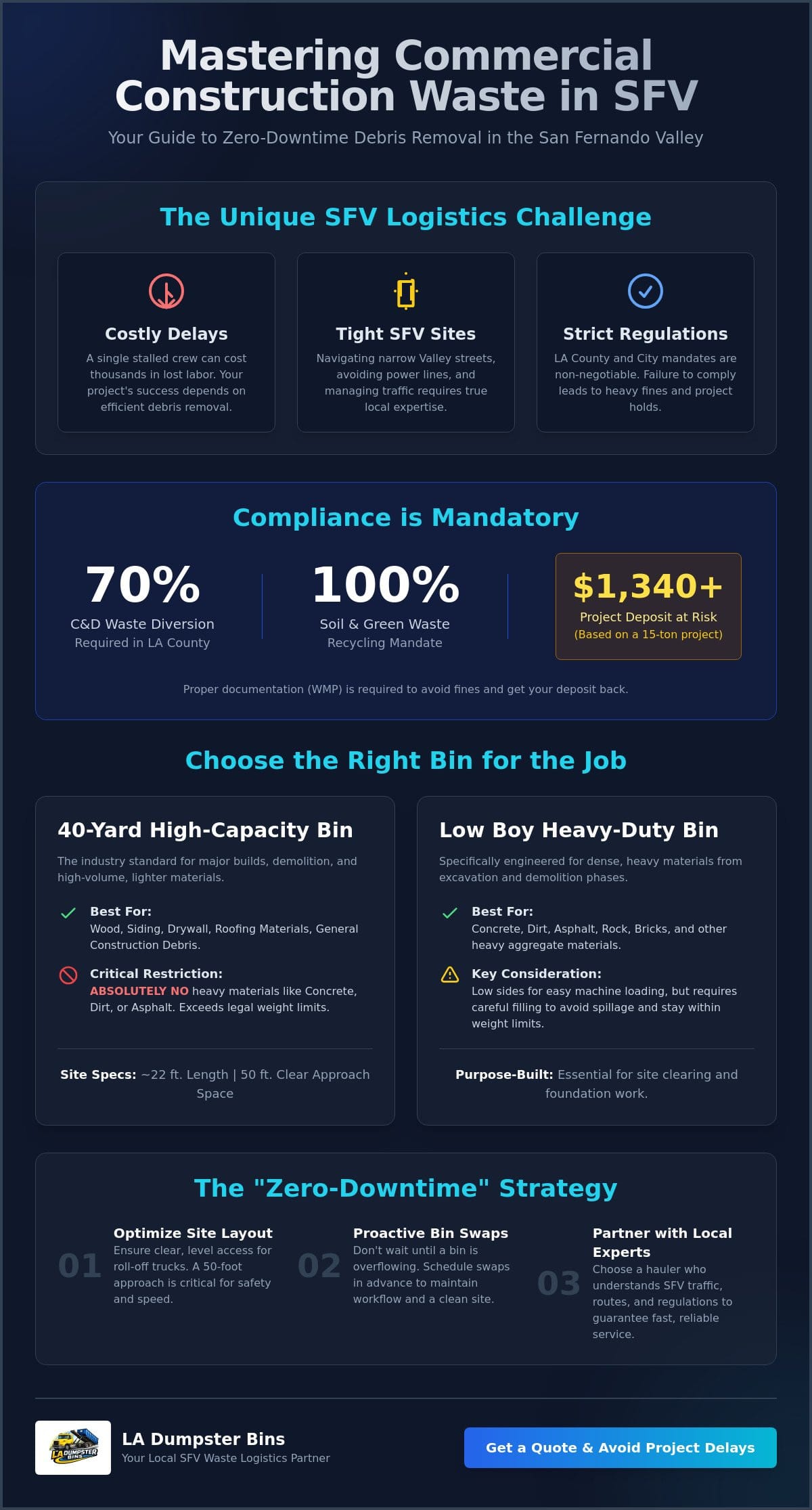
Compliance is mandatory in 2026. The City of Los Angeles requires a 65% diversion rate for C&D waste, while unincorporated areas of LA County demand 70%. If you don’t document where your waste goes, you won’t get your project deposit back. For a 15-ton project, that deposit can reach $1,340. Proper waste segregation on-site is the only way to avoid heavy fines and ensure your permits remain valid. You need a partner who provides the specific documentation required for your Waste Management Plan (WMP) and understands the 100% recycling mandate for land-clearing debris like trees and soil.
Choosing the Right Dumpster Size for Construction Debris
Miscalculating your debris volume is a fast way to blow your budget. If you choose a bin that’s too small, you’re paying for extra hauls and dealing with crew downtime. If it’s too big, you’re wasting valuable job site real estate in crowded areas like Van Nuys or North Hollywood. Effective commercial construction waste management SFV starts with matching the container to the specific phase of your build. Demolition generates high-volume, low-density waste like wood and insulation. Finishing stages produce dense, heavy materials. You need to estimate your volume based on these specific materials to avoid overage fees.
Reusing and recycling construction and demolition (C&D) materials is easier when you have the right container to separate your streams. For most commercial projects, the decision comes down to two primary sizes. Choosing correctly ensures that your project stays compliant with local diversion rates without sacrificing speed. Consider these factors before booking:
- Total square footage of the demo area.
- Type of material (bulky wood vs. heavy masonry).
- Frequency of required swaps to maintain a clean site.
- Available clearance for roll-off truck maneuvering.
High-Capacity Solutions: The 40-Yard Dumpster
The 40 Yard Dumpster is the industry standard for major commercial builds. It handles massive amounts of light-to-medium debris like wood, siding, and roofing materials. These bins require a significant footprint, usually about 22 feet long. Ensure your site has a clear, level area with at least 50 feet of approach space for the truck. Never load these bins with heavy materials like concrete or dirt. They will exceed legal weight limits and create a safety hazard during transport. This size is best for the initial gutting of a building or large-scale new construction.
Versatility for Mid-Sized Projects: The 25-Yard Bin
The 25 yards roll off dumpster is the workhorse for SFV commercial renovations. It fits into tighter urban zones where a larger bin simply won’t go. It’s perfect for drywall, framing scraps, and metal fixtures. This size offers a perfect balance between capacity and site agility. If you’re working on a storefront in Sherman Oaks or a warehouse in Sun Valley, this is often your best bet. You can view bin dimensions and availability to ensure the footprint fits your specific alley or parking lot requirements.
Safety is non-negotiable on a commercial site. Never “top off” a construction bin. Debris must be level with the rim at all times. If material hangs over the sides or sits above the top rail, the driver cannot safely tarp the load for transport. This leads to rejected hauls and safety fines from the city. Always leave a six-inch safety margin at the top to ensure a smooth, zero-downtime swap-out.
Handling Heavy Materials: Concrete, Dirt, and Asphalt in the Valley
Handling heavy materials like concrete, asphalt, and dirt is the most technical part of commercial construction waste management SFV. You can’t treat these like general trash. A standard 40-yard dumpster might look large enough, but it has a weight limit that a few yards of wet dirt will quickly exceed. If you overload a standard bin, the truck won’t be able to lift it. This stalls your project and triggers heavy overweight penalties. You need a specialized approach for dense debris to keep your site moving safely and stay within legal transport limits.
Dense materials require specific containers designed for weight rather than volume. Attempting to mix these with general construction debris is a common mistake that leads to rejected loads at the facility. Effective management means separating these heavy streams at the point of origin. This practice ensures your project remains compliant with California’s C&D recycling guidelines while keeping your disposal costs predictable. In the San Fernando Valley, where job sites are often tight and street weight limits are strictly enforced, the right equipment choice is the difference between a smooth haul and a logistical nightmare.
What is a Low Boy Dumpster?
A Low Boy Dumpster is a specialized bin designed specifically for maximum weight capacity. Unlike standard roll-offs, Low Boys have much lower walls, usually around two to three feet high. This engineering serves two purposes. First, it makes it easier for your crew to load heavy materials like asphalt or concrete using a skid steer or excavator. Second, the lower volume naturally prevents you from accidentally overloading the container beyond what a truck can legally carry. If your project involves digging or tearing up a parking lot, a Low Boy is the only safe and efficient choice.
Concrete and Dirt Disposal Logistics
Separation is key to controlling your bottom line. You must distinguish between “clean” and “mixed” materials before the bin arrives. Clean concrete contains no dirt, trash, or metal. Mixed loads are more difficult to process and often result in higher fees. Remember that Los Angeles County mandates 100% of excavated soil be managed through recycling, reuse, or disposal at an Inert Debris Engineered Fill Operation (IDEFO). Mixing general construction trash into your dirt pile can disqualify the entire load from these facilities. Schedule your swap-outs in a rhythmic cycle during continuous excavation to ensure your digging crew never has to stop for a full bin.
Optimizing Your Job Site for Efficient Debris Removal
Strategic placement of your roll-off container is the difference between a fluid job site and a total bottleneck. In the San Fernando Valley, space is a premium. You don’t have room for a truck to make a twenty-point turn in a narrow Van Nuys alley. Precision placement ensures your crew can reach the bin easily without blocking heavy equipment or incoming material deliveries. Effective commercial construction waste management SFV depends on this spatial planning before the first bin even touches the ground.
Implement a “no-downtime” strategy by scheduling your swaps early. Don’t wait until the bin is overflowing to call for a haul. We recommend scheduling a swap-out when the container is 75% full. This buffer accounts for unpredictable Valley traffic and ensures an empty bin arrives exactly when you need it. Clear communication with your driver is essential. Provide specific gate codes, site contacts, and placement markers to avoid confusion during early morning drop-offs. A well-placed bin keeps your crew moving and your site profitable.
Protecting your site’s physical integrity is just as important as the debris itself. A fully loaded 40 Yard Dumpster exerts immense pressure on the ground. If you’re placing a bin on fresh asphalt or a finished driveway in Sherman Oaks, use 3/4 inch plywood sheets as a buffer. This simple step prevents cracking and surface scarring that could lead to costly repairs during the close-out phase. Your driver can assist with precision placement if the area is prepared before they arrive. This proactive approach shows your client that you value their property while maintaining a high-performance site.
Minimizing Site Disruption
Designate a specific “Waste Zone” that stays clear of active crew movement. If your site is too cramped for on-site placement, you’ll need to utilize the street. Placing a bin on a public SFV street requires a permit from the Los Angeles Bureau of Street Services. Ensure your waste zone is clearly marked with safety cones or reflective tape. This protects your workers and prevents civilian vehicles from accidentally blocking the truck’s access path. A designated zone also makes it easier for your team to sort materials according to local recycling mandates.
Avoiding Hidden Costs and Overage Fees
Dry run fees are the most common avoidable expense in 2026. A dry run happens when a driver arrives but cannot access the bin because a subcontractor parked their vehicle in the way. Ensure the path is clear thirty minutes before your scheduled window. Also, watch for prohibited items. While we handle standard debris, materials like paints, solvents, and treated wood are banned from construction bins. Including these can lead to rejected loads or environmental fines. Avoid losing your refundable project deposit. For a 15-ton project in Los Angeles County, this deposit is $1,340. Proper documentation is the only way to get that money back. You can request a commercial quote to lock in your logistics plan and avoid these common pitfalls.
Why LA Dumpster Bins is the Local Choice for SFV Contractors
Our 24/7 availability sets us apart from standard vendors. Construction doesn’t always happen between nine and five. If you have an urgent need for a bin swap at midnight to prepare for a morning inspection, we are ready to respond. This readiness builds a sense of security for our partners. You can trust that your site will remain clean and compliant without the typical corporate delays. We understand the urgency of the industry. When a project is on the line, we deliver. Our team is responsive, attentive, and ready to solve your logistical problems immediately.
A Partner, Not Just a Vendor
Local knowledge is our greatest asset. We understand the specific traffic patterns and street regulations from Northridge to Studio City. This expertise prevents the delivery delays that plague national franchises. When you call us, you speak directly to someone who knows the Valley. There are no hidden corporate surcharges or complex phone menus. We provide transparent pricing that helps you maintain predictable costs for your project. Whether you are managing a small residential remodel or a massive commercial build, we provide the same level of dependable service. We are a hardworking, no-nonsense provider that values transparency above all else.
Getting Started with Your Next Project
We make the booking process as simple as possible for busy contractors. We know your time is valuable. Our team offers a complimentary price estimate today so you can finalize your project budget with confidence. For commercial accounts, we provide a streamlined booking system designed for high-frequency hauls and multiple site management. This efficiency allows you to focus on the build while we handle the logistics. Our communication rhythm is brisk and logical, moving you from a quote to a delivery as quickly as possible. Don’t let waste logistics become a bottleneck for your team. Take control of your site efficiency right now.
Book Your SFV Construction Dumpster Now
Master Your Site Logistics and Maintain Your Build Schedule
Efficiently managing your debris flow is the key to hitting your 2026 project milestones. You now have the strategies needed to choose between 40-yard containers for demolition and specialized Low Boy bins for heavy materials like concrete or asphalt. By optimizing your site layout and scheduling swaps at the 75% mark, you ensure your crew stays productive with zero downtime. Meeting the 70% recycling mandate in Los Angeles County becomes a simple part of your workflow when you have the right local partner handling your documentation.
LA Dumpster Bins is locally owned and operated in the San Fernando Valley. We understand the specific logistical challenges of our local streets and alleys. We provide 24/7 responsiveness to meet the urgent needs of professional contractors. Whether you need a 10-yard bin for a small renovation or a fleet of 40-yarders for a major build, we’re ready to work. Take the guesswork out of commercial construction waste management SFV and focus on what you do best.
Get a Free Estimate for Your SFV Commercial Project
Your next successful project starts with a clean and organized job site. We look forward to helping you build the future of the Valley.
Frequently Asked Questions
What is the largest dumpster size available for SFV construction sites?
The 40 Yard Dumpster is the largest container we offer for San Fernando Valley projects. It’s specifically designed to handle high-volume, low-density debris like wood, insulation, and general framing materials. This size is the industry standard for large-scale commercial construction waste management SFV during the gutting or initial build phases of a project. It provides the capacity needed to keep a large crew working without constant interruptions.
Can I put concrete and dirt in a standard 40-yard dumpster?
No, you cannot put heavy materials like concrete, dirt, or asphalt in a 40-yard bin. These materials are extremely dense and will quickly exceed the legal weight limit of a standard roll-off truck. Overloading a large bin creates a major safety hazard and results in rejected hauls. For heavy debris, you must use a Low Boy Dumpster, which is engineered with lower walls to ensure the load remains within legal transport limits.
Do I need a permit for a dumpster in the San Fernando Valley?
You only need a permit if the dumpster is placed on a public street or in a public right-of-way. These permits are issued by the Los Angeles Bureau of Street Services. If the bin is placed entirely on private property, such as a parking lot or a construction site footprint, no permit is required. We recommend checking your specific site plan early to avoid delivery delays caused by missing documentation.
What materials are prohibited in LA Dumpster Bins containers?
Hazardous materials are strictly prohibited in all our containers. This includes items like paints, solvents, batteries, electronics, and treated wood. These materials require specialized handling and cannot be processed at standard C&D recycling facilities. Including prohibited items in your bin can lead to environmental fines and rejected loads. Always ensure your crew is trained on proper waste segregation to keep your project compliant and avoid extra fees.
How much space is needed for a 40-yard roll-off delivery?
A 40-yard bin requires a level area approximately 22 feet long and 8 feet wide. However, the delivery truck needs at least 50 feet of straight-line approach space to safely drop or pick up the container. You also need to ensure there are no low-hanging power lines or tree branches, as the truck’s lift mechanism reaches a significant height during operation. Clear the area of all subcontractor vehicles before the scheduled delivery window.
What happens if my construction dumpster exceeds the weight limit?
If a bin is too heavy, the truck’s hydraulic system will be unable to lift it onto the bed. This results in a “dry run” fee because the driver cannot complete the haul. You will be responsible for removing the excess material until the bin reaches a safe weight for transport. It’s much more cost-effective to use specialized Low Boy bins for heavy materials like masonry and soil from the start of your project.
Do you offer same-day dumpster delivery in Van Nuys or Northridge?
Delivery timing depends on current local demand and our driver schedules. We recommend that contractors call our local dispatch line directly to check the earliest available drop-off times for Van Nuys or Northridge job sites. We prioritize responsiveness for professional contractors to help keep your project on schedule. Planning at least 24 to 48 hours in advance is the best way to guarantee a specific morning delivery slot.
How do I schedule a swap-out for my ongoing commercial project?
Contact our team directly once your current bin reaches approximately 75% capacity. This proactive approach is a core part of effective commercial construction waste management SFV because it prevents your crew from standing around a full bin. We offer a streamlined booking process for commercial accounts to make scheduling multiple hauls simple and fast. Clear communication about gate codes and placement ensures our drivers can complete the swap without site disruption.