What if the heavy material dumpster San Fernando Valley homeowners choose for a renovation ends up costing double because of the weight of the debris? It’s a common trap. You already know that concrete, asphalt, and soil are incredibly dense, but standard bins aren’t always designed for that weight. It is frustrating to face hidden overage fees or worry about a heavy truck damaging your driveway during delivery.
This 2026 guide teaches you how to select the right equipment to stay legal and on budget. You’ll learn how to avoid expensive overloading penalties and comply with City of Los Angeles permit regulations. We will cover why the low boy dumpster is the industry standard for heavy debris and how to choose the best residential or commercial roll off dumpster rental for your project. Follow these steps for a seamless delivery on even the tightest SFV streets.
Key Takeaways
- Learn why dense debris like concrete and dirt requires a specialized heavy material dumpster San Fernando Valley rental to ensure safe transport.
- Understand the mechanical differences between a 10-yard Low Boy and standard roll-offs to prevent dangerous overloading and equipment damage.
- Identify when your project requires a street use permit from the Los Angeles Bureau of Street Services to avoid regulatory fines.
- Master a simple framework for estimating material volume and identifying debris types to eliminate hidden overage fees.
- Discover how local expertise in San Fernando Valley logistics ensures seamless delivery and placement on narrow residential streets.
What Qualifies as a Heavy Material Dumpster in San Fernando Valley?
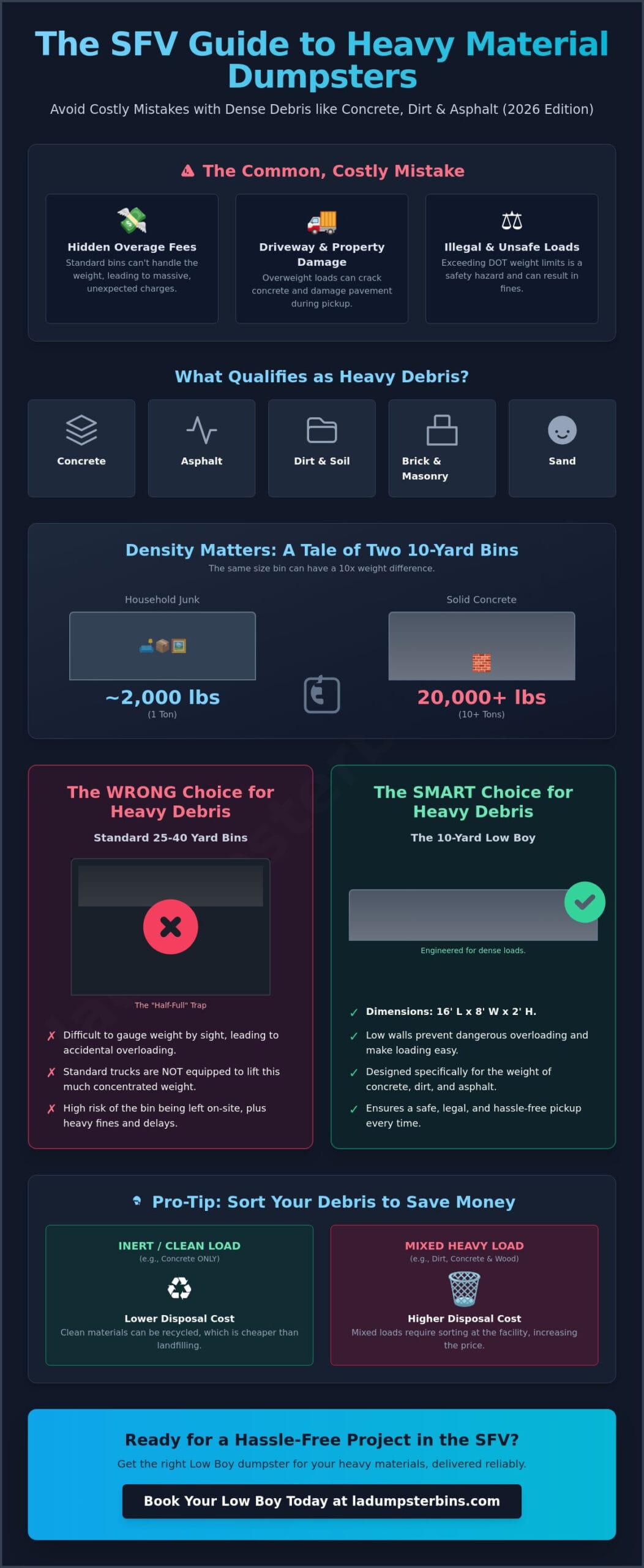
Heavy materials aren’t just bulky; they’re incredibly dense and demand specific equipment. In the San Fernando Valley, this category primarily includes concrete, dirt, brick, asphalt, and sand. These materials require a specialized heavy material dumpster San Fernando Valley rental, specifically a “Low Boy.” Standard containers are designed for lighter municipal waste, but heavy debris can quickly exceed legal weight limits. You’ll typically need a Low Boy for common local projects like pool removals, patio demolitions, or driveway replacements. Using the wrong bin isn’t just inefficient; it’s a safety risk for the driver and the pavement.
The Science of Weight: Density Matters
Understanding weight density is critical for any construction project. A 10-yard dumpster filled with household furniture might only weigh a few thousand pounds. That same 10-yard bin filled with solid concrete can weigh over 20,000 pounds. This is why understanding What is a roll-off dumpster? and its configuration matters so much. A standard 40-yard bin has walls that are too high for heavy materials. If you fill it with dirt, the truck won’t be able to lift it off the ground. Moisture content is another hidden factor. If your dirt pile gets rained on, the water weight can double the load’s mass. This is why volume-based pricing usually fails for heavy projects. You must plan for the actual weight of the material to avoid massive overage fees.
Inert vs. Mixed Heavy Loads
Efficiency depends on how you sort your debris before the truck arrives. Inert waste refers to materials that don’t decompose or produce chemical reactions, such as clean concrete, brick, or sand. These are “source-separated” materials. If you keep your concrete pure, it’s often cheaper to dump because it can be recycled into road base. However, mixing dirt with general construction debris creates a “mixed load.” These mixed loads are harder to process and typically cost more at San Fernando Valley disposal sites. Keeping materials separated at the source is the smartest way to manage your budget. It ensures your waste is handled legally and gives you the best chance at lower disposal rates.
When planning your SFV project, identify exactly what you’re hauling. If you’re digging out a foundation, you’re dealing with dirt. If you’re breaking up a walkway, you’re hauling concrete. Don’t mix them if you want to save money. A dedicated Low Boy dumpster is the only reliable way to move these materials without risking a fine for an overweight vehicle on city streets. It’s about choosing the right tool for a heavy-duty job.
Low Boy vs. Standard Roll-Offs: Choosing the Right Bin
Choosing the wrong container for a construction project is a costly mistake. For heavy materials, the physical size of the bin is less important than its weight capacity. A standard 40-yard dumpster is designed for light, bulky items like furniture or drywall. If you fill that same bin with concrete, the truck will be physically unable to lift it. Most roll-off trucks have hydraulic limits that prevent them from hauling 40 cubic yards of dense material. Attempting to move such a load risks snapping cables, damaging the truck’s axles, and cracking your driveway under the extreme pressure.
Safety is the primary reason for these equipment distinctions. Overloaded containers are a major road safety hazard. They can cause tire blowouts or braking failures during transport through the San Fernando Valley. If you need a reliable Low Boy dumpster for your renovation, selecting the specific 10-yard model is the only way to guarantee a safe and legal pickup.
The 10-Yard Low Boy: The Industry Standard
The 10-yard Low Boy is the specialized tool for heavy material dumpster San Fernando Valley projects. These bins typically measure 16 feet long, 8 feet wide, and only 2 feet high. The short walls serve a functional purpose. They make it easier to toss heavy chunks of asphalt or shovel dirt over the side. These dimensions also act as a physical safeguard against overloading. Ideal for sidewalk repairs and masonry work, these bins ensure the weight remains concentrated and manageable for the hauling equipment. When loading, always keep the material level with the rim. Anything protruding above the top makes the load illegal to transport on California highways.
Why Big Bins Fail for Heavy Hauling
Many contractors fall into the “half-full” trap. They rent a 25 or 40-yard bin thinking they will just fill it halfway with dirt. This rarely works in practice. It is difficult to gauge weight by sight, and you will likely exceed DOT weight regulations before the bin looks even a quarter full. Local law enforcement in the San Fernando Valley frequently checks for overweight vehicles. If your bin is over the legal limit, the driver will leave it on-site, and you’ll be stuck with a “dry run” fee plus the labor cost of unloading the excess material.
Regulation compliance is non-negotiable. You should consult the San Fernando Valley dumpster permits guidelines to understand how weight limits and recycling requirements affect your project. Oversized containers also have a larger footprint. On tight residential streets, a 40-yard bin takes up significant space and is much heavier even when empty. Sticking to a 10-yard Low Boy protects your property and keeps your project moving without administrative delays.
Navigating San Fernando Valley Regulations and Permits
Compliance is the most overlooked part of renting a heavy material dumpster San Fernando Valley. Local regulations aren’t just suggestions; they’re strictly enforced rules that carry heavy fines if ignored. If you plan to place your bin on a public street, sidewalk, or alley, you must obtain an “A” Permit. The Los Angeles Bureau of Street Services, also known as StreetsLA, manages these requirements for most of the Valley. Failing to secure this paperwork before the truck arrives can result in an immediate citation and the removal of the container at your expense.
Geography also plays a role in the San Fernando Valley. Many residential areas, especially those in hillside zones, have narrow streets with strict weight restrictions. If your project is in a high-elevation neighborhood, the city may limit the size of the delivery vehicle or the total weight of the load. LA Dumpster Bins understands these local nuances. We help you determine if your specific street can handle the weight of a loaded 10-yard Low Boy and advise on the best placement to keep your project legal.
Street Placement vs. Private Property
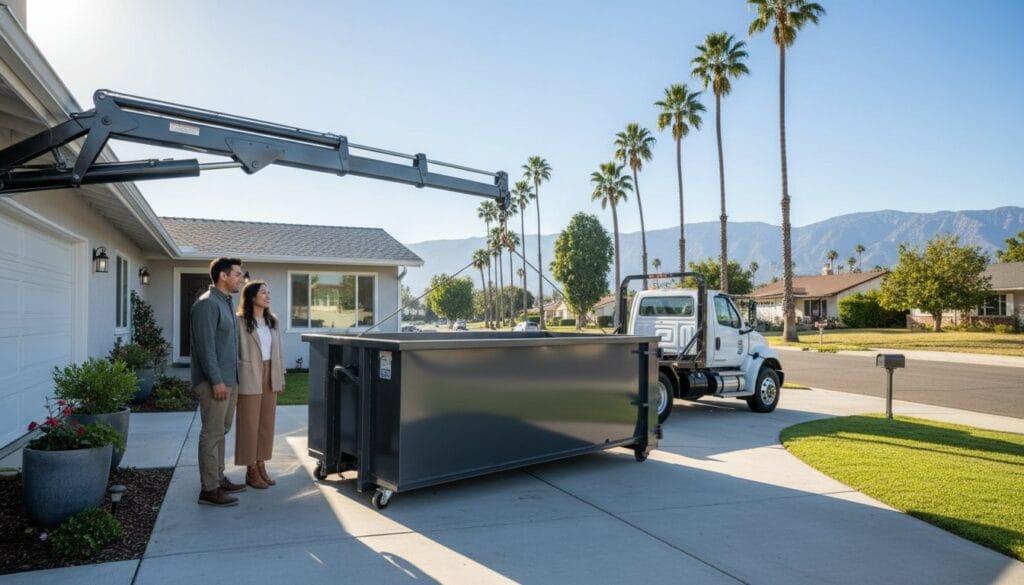
Placement choice dictates your permit needs. In neighborhoods like Northridge or Sherman Oaks, placing a bin on your private driveway usually exempts you from city permits. However, you must protect your property. Heavy bins can crack standard residential concrete. We recommend placing thick wood planks under the bin’s rollers to distribute the weight. If you must use the street, safety is the priority. StreetsLA requires the use of reflectors and barricades to maintain traffic flow. You’re responsible for ensuring the bin doesn’t block hydrants, driveways, or bus stops. Proper planning ensures you don’t face a “dry run” fee because the driver couldn’t safely drop the bin.
Prohibited Items in Heavy Material Bins
Heavy material bins are for inert waste only. You cannot mix hazardous waste like motor oil, wet paint, or chemicals with your dirt and concrete. Doing so contaminates the entire load. This prevents recycling and leads to massive environmental fines. When hauling concrete, rebar is generally acceptable as long as it’s cut flush with the concrete surface. Soil disposal is even more regulated. Environmental rules for the LA Basin require that soil be “clean” and free of organic debris like roots or sod. Following California’s C&D recycling regulations helps keep your disposal costs down and keeps your project environmentally responsible. Keeping your load pure is the fastest way to avoid secondary sorting fees at the landfill.
Avoiding Hidden Costs: An SFV Buying Framework
Renting a heavy material dumpster San Fernando Valley requires a tactical approach. You don’t want to see a surprise charge on your final invoice. Many national providers hide weight-limit surcharges in the fine print. Follow this five-step framework to ensure your project stays on budget and on schedule.
- Step 1: Estimate your material volume. A 10-yard Low Boy holds approximately 2 to 3 tons of debris. This is roughly equivalent to 3 pickup truck loads.
- Step 2: Identify the specific material. Determine if you’re hauling clean concrete, dirt, or a mixed load. Mixed loads are always more expensive at the landfill.
- Step 3: Check for overhead obstructions. Look for low-hanging power lines or tree branches at your SFV site. The truck needs significant vertical clearance to tilt the bin.
- Step 4: Verify weight limits. Ask your provider about the specific tonnage cap for your 10-yard bin before booking.
- Step 5: Secure permits. If you must place the bin on a public street, obtain your StreetsLA “A” permit. These typically cost between $75 and $150.
If you’re ready to start your project without the guesswork, you can rent a Low Boy dumpster directly from a local expert who knows the Valley’s specific requirements.
Understanding Overage Fees
Most rentals include a “tonnage cap.” This is the maximum weight allowed for the base price. If your load of wet dirt exceeds this limit, you’ll pay a fee for every additional ton. Another common cost is the “dry run” fee. This happens when the truck arrives but cannot safely lift the bin because it’s too heavy or blocked by parked cars. For contractors, “flat rate” pricing for clean dirt or concrete is often a better value. It eliminates the anxiety of weighing the load and provides a predictable cost for the entire project.
Site Preparation for Heavy Loads
Site access is a major hurdle in older San Fernando Valley neighborhoods. Many homes in areas like Van Nuys or Pacoima have narrow alleys that are difficult for large trucks to navigate. Ensure the delivery route is clear of vehicles and trash cans. The surface where the bin sits must be level. A heavy bin on an incline can shift or sink into soft soil, making it impossible for the truck to retrieve. Coordinate your delivery time to avoid local street sweeping schedules. This prevents parking tickets and ensures the truck has a clear path to your property.
Why LA Dumpster Bins is the SFV Choice for Heavy Hauling
Local projects demand local expertise. When you need a heavy material dumpster San Fernando Valley rental, you don’t want a middleman or a national call center. You need a partner that maintains a specialized inventory of 10-yard Low Boys specifically for concrete and dirt. We focus on the equipment that works for the Valley’s unique geography. Our team understands the logistical challenges of narrow residential streets and the weight restrictions of hillside neighborhoods. We provide a dependable service that keeps your job site clean and your project moving forward without delays.
Reliability is our hallmark. We offer 24/7 availability to meet the urgent needs of demolition crews and construction teams. Whether it’s a planned pool removal or an emergency pipe repair, we’re ready to dispatch. Our pricing is straightforward. We don’t use complex formulas or hide fees in the fine print. You get a no-nonsense estimate that allows you to budget accurately from day one. This transparency is why local homeowners and professional contractors trust us for their heavy hauling needs.
Our Commitment to the Valley
We serve the entire region from North Hollywood to Chatsworth with prompt, local dispatch. Our “no-fluff” approach is designed to save you time and money. We don’t waste your time with sales pitches or unnecessary upgrades. Instead, we provide the exact bin you need for the material you have. Local landscaping and pool contractors frequently tell us that our punctuality is what sets us apart. One Northridge-based contractor recently noted that our ability to place a Low Boy in a tight alley saved his crew hours of manual labor. We take pride in being a community fixture that helps build and renovate the San Fernando Valley.
How to Get Your Heavy Material Estimate
Booking your rental is a simple process that takes under five minutes. To get started, have your material type and project duration ready. Tell us if you’re hauling clean concrete, dirt, or asphalt so we can provide the most accurate quote. We’ll ask about your delivery location to check for any overhead obstructions or permit requirements we discussed earlier. Once you provide the details, we’ll handle the logistics. You can get your free heavy material dumpster quote today and see why we are the preferred choice for heavy hauling in the SFV. We make the transition from debris to a clean site as seamless as possible.
Streamline Your San Fernando Valley Debris Removal
Managing a project involving concrete, dirt, or asphalt requires more than just a large bin. It requires the correct equipment for the weight of the load. Choosing a 10-yard Low Boy ensures you stay within legal weight limits and avoid the high costs of overloading fees. You also protect your property and comply with StreetsLA permit regulations. By following the buying framework we discussed, you can move forward with confidence and clarity.
LA Dumpster Bins provides the specialized Low Boy inventory needed for these demanding tasks. Our team offers local SFV permit expertise to help you navigate neighborhood logistics from Northridge to Sherman Oaks. With 24/7 dispatch availability, we’re ready to support your timeline whenever the work begins. We prioritize transparent pricing and efficient delivery so you can focus on finishing your renovation or construction job.
Rent a Heavy Material Low Boy in San Fernando Valley Now to secure the best equipment for your project. Don’t let your heavy material dumpster San Fernando Valley rental become a source of stress. We’re here to make your debris disposal predictable, safe, and professional. Let’s get your project started today.
Frequently Asked Questions
How much concrete can I put in a 10-yard low boy?
You can fill a 10-yard low boy to the rim with concrete, which is roughly 10 cubic yards of material. This load typically weighs between 10 and 12 tons. You must keep the debris level with the top of the bin. If the concrete is piled higher than the side walls, the truck cannot legally transport it on San Fernando Valley roads.
Do I need a permit for a dumpster in my driveway in San Fernando Valley?
No, a permit is generally not required for placing a dumpster on private property like a driveway. Permits are only mandatory when the bin occupies public property such as a street, sidewalk, or alley. Always confirm your specific city’s rules if you live in incorporated areas like the City of San Fernando, as they may differ from broader Los Angeles regulations.
Can I mix dirt and concrete in the same heavy material dumpster?
You can mix them, but it is often more expensive. Mixed loads of dirt and concrete are classified as “mixed inert” waste. This usually results in higher disposal fees compared to a “clean” load of just concrete. If you want the most cost-effective heavy material dumpster San Fernando Valley experience, keep these materials separated whenever possible.
What happens if my heavy material dumpster is overloaded?
If the bin is too heavy, the driver will not be able to lift it onto the truck. You will likely be charged a “dry run” fee for the failed pickup attempt. You’ll then need to remove enough material to bring the weight down to a manageable level. Overloading also risks damaging your driveway and the truck’s hydraulic system.
How much space does the truck need to drop off a low boy in the SFV?
A roll-off truck needs approximately 60 feet of straight-line space to drop off a 10-yard low boy. You also need at least 23 feet of vertical clearance to allow the truck to tilt the bin into place. In tight San Fernando Valley neighborhoods, ensure there are no parked cars or low-hanging wires obstructing the delivery path.
Are there weight limits for dumpsters placed on San Fernando Valley streets?
Yes, StreetsLA enforces strict weight limits for containers on public roads. Most standard permits allow for a specific tonnage, and exceeding this can lead to fines. Hillside areas in the Valley often have even lower weight thresholds to protect the integrity of the asphalt. Always disclose your material type so your provider can ensure the load remains street-legal.
Can I put rebar-filled concrete in a low boy dumpster?
You can put concrete with rebar in a low boy, provided the metal is cut flush with the concrete surface. Protruding rebar creates a safety hazard during transport and can interfere with the recycling process. Most local recycling centers accept concrete with rebar, but they may charge a different rate than they do for “clean” concrete without metal reinforcement.
How do I avoid driveway damage when renting a heavy material bin?
Place two-by-fours or plywood sheets on the ground before the truck arrives. The driver will set the bin’s rollers onto the wood instead of directly onto your concrete or asphalt. This simple step distributes the weight of the heavy material dumpster San Fernando Valley and prevents the heavy load from causing cracks or indentations in your driveway surface.