Did you know that placing a roll-off bin on a Los Angeles street without a permit could cost you more in city fines than the actual rental? Dealing with the Bureau of Street Services is often the most stressful part of a renovation or cleanout. You want to focus on the work, not on whether you’re following the latest Los Angeles dumpster permit requirements or if you’ve accidentally crossed from the City into an unincorporated part of LA County.
We understand that the paperwork feels like a major barrier to getting your project started. That’s why we’ve simplified the process for you. This guide promises to give you a clear “yes or no” on whether your specific job needs city approval. You’ll learn how to avoid costly penalties, where to apply through the EPIC-LA portal, and how the June 9, 2026 fee updates from StreetsLA impact your planning. We’re covering everything from “A” permits to proper placement rules so your delivery is fast and hassle-free.
Key Takeaways
- Determine if your placement falls under the “Public Right-of-Way” rule to see if you can bypass the permitting process by using private property.
- Understand the latest 2026 Los Angeles dumpster permit requirements to protect your project budget from unexpected city penalties and non-refundable fees.
- Distinguish between StreetsLA and LA County jurisdictions so you can submit your application through the correct portal without delays.
- Learn how to properly prep your site with street pads and safety markers to comply with strict local traffic codes and protect the asphalt.
- Simplify your logistics by matching your waste volume to the right 10, 25, or 40-yard roll-off bin for a faster, hassle-free delivery.
Do You Actually Need a Dumpster Permit in Los Angeles?
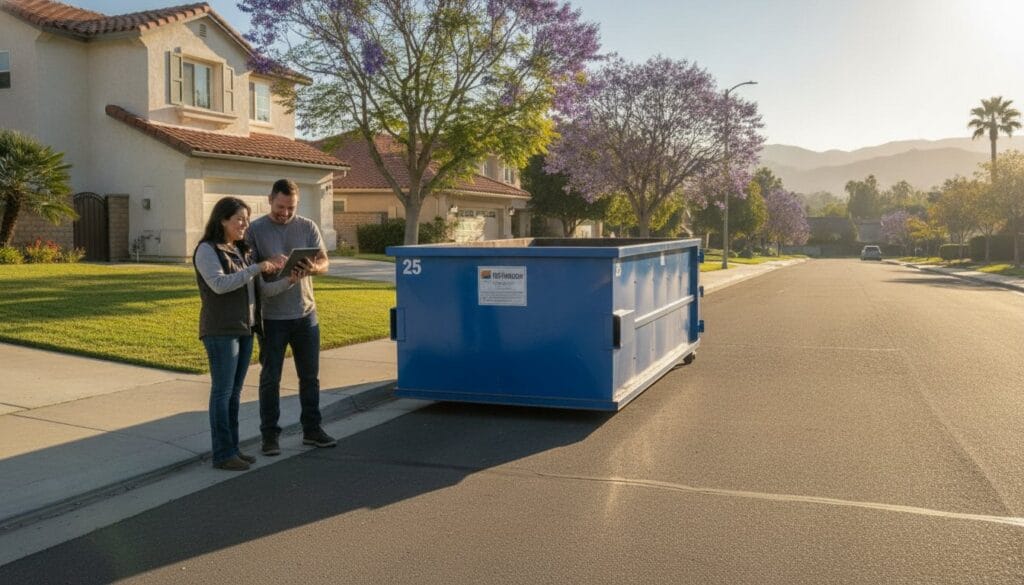
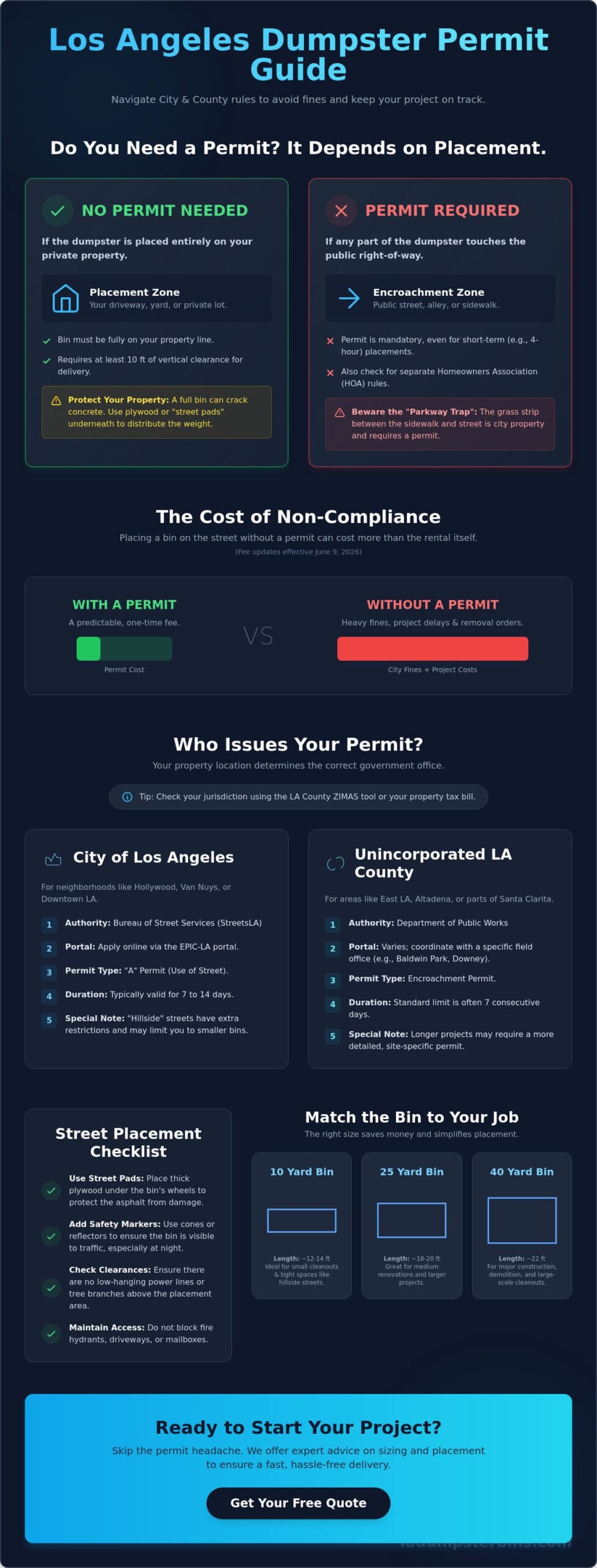
The short answer depends entirely on where the bin sits. If any part of the roll-off container touches a public street, sidewalk, or alley, you must have a permit. Los Angeles dumpster permit requirements are strict because the city needs to ensure emergency vehicles and traffic can pass safely. Placing a bin on public property without authorization is the fastest way to trigger a city inspection and a heavy fine.
Many residents fall into the “Parkway trap.” This is the strip of land between the sidewalk and the street. Even if you mow the grass there, the city owns it. Placing a bin on this strip without city approval often leads to a Bureau of Street Services inspector issuing a citation. For 2026, the city has increased its monitoring of these areas to keep public rights-of-way clear and accessible.
The Driveway Alternative: Saving Time and Money
Using your own property is the fastest way to avoid city paperwork. Before you order, measure your space. A 10-yard dumpster typically needs 12 to 14 feet of length. A 25 yards roll off dumpster requires about 18 to 20 feet. Always ensure you have at least 10 feet of vertical clearance for the delivery truck to lift and drop the bin. If the equipment stays entirely on your concrete or dirt lot, you don’t need to file with the city.
Weight is a major factor for private placement. A fully loaded bin can weigh several tons. This pressure can crack older residential concrete or leave ruts in asphalt. We recommend placing thick plywood or “street pads” down first. This simple step protects your property and keeps the project cost-effective. Choosing a smaller footprint, like our 10-yard option, often makes private placement possible even on narrow Los Angeles lots.
When the Street is Your Only Option
If your driveway is too steep or too short, the street is your only choice. This area is known as the “Encroachment zone.” You must apply for an “A” permit through StreetsLA to use this space. Don’t assume a quick turnaround job is exempt. Even if the bin is there for only four hours, it’s legally required to have a permit. The city doesn’t offer “grace periods” for street placement.
Check your local neighborhood rules too. While the city grants the legal right to use the street, your Homeowners Association (HOA) might have separate restrictions on duration or bin size. Always clear it with both offices to avoid double fines. Following Los Angeles dumpster permit requirements ensures your project stays on schedule without legal interruptions from the Bureau of Street Services.
Understanding Los Angeles Encroachment Permits
Determining which government office controls your curb is the first step in the process. The City of Los Angeles and Unincorporated Los Angeles County have different rules, fees, and application portals. If you live in a neighborhood like Van Nuys or Hollywood, you’ll deal with the City. If you’re in an area like East Los Angeles or Altadena, you likely fall under County jurisdiction. Using a tool like ZIMAS or checking your property tax bill will confirm your status quickly. Knowing your zone is essential because Los Angeles dumpster permit requirements are not one-size-fits-all.
The Los Angeles Bureau of Street Services, or StreetsLA, manages all dumpster permits within city limits. You’ll need to submit your request through the EPIC-LA online portal. This system requires a clear site map showing exactly where the bin will sit relative to driveways and fire hydrants. You must also provide the exact dimensions of your rental, whether it’s a 10 Yard Dumpster or a 40 Yard Dumpster. Most residential permits are valid for 7 to 14 days, but extensions are possible if you apply before the original expiration.
City of Los Angeles (StreetsLA) Requirements
When applying through StreetsLA, you’ll specifically look for the “Use of Street” permit. Specify if you are on a “Hillside” street. These narrow roads have extra restrictions to ensure fire trucks can pass. You might be limited to a smaller 10-yard bin or required to provide additional traffic control like cones or reflectors. If you aren’t sure which size fits your street’s footprint, you can consult with our local team for expert sizing advice. Standard residential permits usually cover a two-week window, which is enough for most home cleanouts or roof replacements.
Unincorporated LA County (Public Works) Rules
For those in unincorporated areas, the County Department of Public Works handles Encroachment Permits. Unlike the city’s centralized system, the County often requires you to coordinate with a specific field office. Offices in Baldwin Park, Downey, or Santa Clarita manage their respective regions. The standard permit for a bin on a County road right-of-way typically has a 7-day consecutive limit. If your project lasts longer, you may need a site-specific permit. This often requires more detailed insurance documentation and a longer review time. Always verify Los Angeles dumpster permit requirements with your specific field office at least one week before your project begins.
Permit Costs, Fines, and Duration in 2026
Budgeting for your project requires looking beyond the rental price. On June 9, 2026, the Los Angeles City Council approved updated fees for StreetsLA. These changes marked the first major update to permit costs since 1991. Most residents should expect a two-part billing structure. First, you pay a non-refundable application fee. This covers the administrative time to review your site map. Second, you pay a daily use fee based on how long the bin occupies the public right-of-way. Depending on the duration and location, city permit costs typically range from $20 to $200.
If your project hits a delay, don’t wait for the permit to expire. You must renew it at least 48 hours before the end date through the EPIC-LA portal. Late renewals often trigger new application fees, effectively doubling your administrative costs. Project timelines change, but staying ahead of the paperwork keeps your budget predictable. Following Los Angeles dumpster permit requirements is the only way to ensure your bin isn’t hauled away mid-project.
Factors Influencing Your Total Permit Bill
The type of street determines your base rate. Residential side streets are generally more affordable than commercial arterial roads. If your property sits on a major boulevard, “Peak Hour” restrictions may apply. The city often charges higher rates for bins that occupy transit lanes during morning and evening commutes. You also pay for the footprint. A 40 Yard Dumpster takes up more curb space than a 10 Yard Dumpster. This means you’re effectively renting more “parking spaces” from the city. If your permit requires safety lights or barricades for night visibility, these overhead costs will add to your total bill.
Avoiding Fines and Impoundment
Don’t assume you can hide a bin. StreetsLA responds to 50,000 to 60,000 service requests annually. Many of these are reports of unpermitted obstructions. If an inspector spots your bin without a valid permit, they’ll issue a “Red Tag.” This is a formal notice of violation that can lead to daily fines. These penalties often exceed the original cost of the permit by a wide margin. It’s a common mistake to think the bin owner’s annual business permit covers your site. It does not. Every residential street placement requires its own site-specific permit to comply with Los Angeles dumpster permit requirements. If the bin is impounded, you’ll be responsible for both the city’s towing fees and the rental company’s recovery costs.
Preparing Your Site for Street Placement
Securing your paperwork is the first step, but physical site preparation is what prevents delivery delays. A standard roll-off truck needs at least 50 feet of straight-line clearance to drop a bin safely. If cars are parked in your designated spot on delivery day, the driver can’t complete the drop. This results in “dry run” fees that eat into your budget. Clear the area early and use traffic cones to save the space. This ensures you stay compliant with Los Angeles dumpster permit requirements while keeping your neighbors happy.
Surface protection is another critical step. Los Angeles asphalt can soften in the sun, making it vulnerable to the high pressure of a loaded bin. We always recommend placing two large sheets of thick plywood where the bin’s rollers will land. This distributes the weight and prevents the metal from gouging the public street. If you damage the asphalt, the city may hold you responsible for repair costs even if you have a valid permit. Taking these small precautions protects your wallet and the neighborhood infrastructure.
Safety and Visibility Standards
Visibility is a major concern for the Bureau of Street Services. Per LA code, you should place high-visibility traffic cones at the front and rear corners of the dumpster. If your project is in a high-traffic area or a narrow Hillside neighborhood, the city might require reflective tape or battery-powered flashing lights for nighttime safety. Maintaining a clear “Emergency Access” width of at least 10 to 12 feet is mandatory on most residential streets to allow fire trucks to pass.
Heavy Load Logistics (Low Boys)
If you’re disposing of “heavy fill” like concrete, brick, or dirt, you’ll need a Low Boy Dumpster. These specialized 10-yard bins have shorter walls to prevent overloading. Because these materials are extremely dense, the weight per square inch is much higher than a standard bin. The city has strict maximum weight limits for street-placed containers to protect underlying utilities. If you’re tackling a heavy demolition project, contact us for a Low Boy quote to ensure you have the right equipment for the job.
How LA Dumpster Bins Simplifies Your Project
Navigating the red tape of city permits shouldn’t stall your project. We provide the equipment and the local expertise needed to keep your job site compliant. Our team understands how Los Angeles dumpster permit requirements change based on your specific street and neighborhood. We help you choose the right container so you can focus on the work instead of the paperwork. Whether you need a Residential Roll Off Dumpster Rental for a garage cleanout or a Commercial Roll Off Dumpster Rental for a construction site, we have you covered. We act as a practical partner to ensure your logistics are handled with professional efficiency.
We understand the logistical hurdles of working in Southern California. Our service is built on clarity, efficiency, and dependability. We don’t just drop off a bin; we provide a service-oriented approach that prioritizes your timeline. By matching your debris volume to the perfect container, we help you manage city regulations without the stress. Our goal is to provide a hassle-free experience from the moment you call for a quote until the final pickup.
Matching the Bin to Your Permit Status
Our 10 Yard Dumpster is a favorite for residential cleanouts because it fits into spaces where larger bins can’t go. This often saves homeowners the cost and time of applying for an “A” permit by keeping the bin on private property. If you’re managing a larger site, our 40 Yard Dumpster provides the capacity needed for major demolition or commercial hauls. We also offer a 25 yards roll off dumpster for mid-sized renovations that need more space than a standard small bin. We recommend consulting with our team before you start the EPIC-LA application process. We can help you determine if a street placement is truly necessary or if a different bin size could save you the administrative headache.
Direct Service for the San Fernando Valley
Local knowledge matters when navigating the complex grid of the San Fernando Valley. Our drivers are professionals who understand the challenges of narrow streets and specific neighborhood quirks. We know the difference between the wide boulevards of Chatsworth and the tight residential pockets of Sherman Oaks. We offer a specialized Low Boy Dumpster specifically for asphalt, dirt, and concrete. These materials are too heavy for standard bins and require specialized handling to stay within legal weight limits. Our drivers prioritize safety and precision during every delivery to protect your property and the public right-of-way. We are always ready to respond to your immediate logistical needs with speed and value.
Get a Free Estimate for Your LA Dumpster Rental
Get Your Project Moving Today
Managing a renovation or cleanout is hard enough without worrying about city inspectors. Remember that choosing private property placement is the easiest way to bypass paperwork entirely. If the street is your only option, identifying whether you fall under StreetsLA or LA County jurisdiction is your first priority. Proper site preparation with plywood and safety cones protects the asphalt and keeps you in line with the latest Los Angeles dumpster permit requirements. These simple steps prevent costly red tags and project delays.
We’ve served the Los Angeles and San Fernando Valley areas since 2021. Our team provides specialized Low Boy bins for heavy concrete and dirt projects to ensure safe and legal hauling. We’re available 24/7 for rental inquiries to help you solve logistical problems at any hour. Don’t let permit confusion stop your progress. Rent Your Dumpster Today – Get a Free Quote and let us handle the heavy lifting. You’re now ready to tackle your project with confidence and clarity.
Frequently Asked Questions
Do I need a permit if the dumpster is on my driveway?
No permit is required for dumpsters placed entirely on your driveway or other private property. Los Angeles dumpster permit requirements only apply to the public right-of-way, such as streets, sidewalks, and alleys. If you have the space on your lot, private placement is the best way to save on city fees and avoid the application process through the EPIC-LA portal.
How much does a Los Angeles dumpster permit cost in 2026?
A standard dumpster permit in Los Angeles typically costs between $20 and $200. This total includes a non-refundable application fee and a daily use fee. On June 9, 2026, StreetsLA updated these fees for the first time in over thirty years. Costs vary based on your specific location and the number of parking spaces the bin occupies.
How long does it take to get a permit from the Bureau of Street Services?
You should apply for your permit at least one week before your scheduled delivery date. This lead time allows the Bureau of Street Services to review your site map and process your payment. Applying early through the online portal prevents delivery delays and ensures your bin is legally posted the moment it arrives at your curb.
Can I put a dumpster on the sidewalk if it is blocked off?
No, you cannot place a dumpster on the sidewalk even if you block it off. City regulations require dumpsters to be placed at least five feet away from building openings and clear of all emergency access points. Blocking a sidewalk creates a safety hazard for pedestrians and will result in an immediate citation from a city inspector.
What happens if I rent a dumpster without a permit in LA?
Placing an unpermitted bin on a public street results in a “Red Tag” violation and significant city fines. StreetsLA responds to over 50,000 service requests annually and actively monitors for obstructions. If the bin isn’t permitted or moved quickly, the city may impound the container. This leaves you responsible for both the fines and the recovery costs.
Do 10-yard Low Boy dumpsters have different permit rules?
While the permit requirements for a Low Boy Dumpster are the same as standard bins, their weight requires extra caution. These containers handle heavy debris like concrete and dirt, which can easily damage city asphalt. You must follow all standard placement rules while ensuring you use heavy-duty street pads to prevent surface gouging.
Does LA Dumpster Bins provide the permit for me?
We provide the expert guidance you need to understand the process, but the permit is typically the responsibility of the property owner or contractor. We help you determine which size, such as a 10 Yard Dumpster or 40 Yard Dumpster, best fits your site footprint. Always verify current Los Angeles dumpster permit requirements with the Bureau of Street Services before finalizing your rental.
How many days is a standard LA encroachment permit valid for?
A standard “A” permit for a dumpster in the City of Los Angeles is usually valid for 7 to 14 days. If your project takes longer than expected, you must apply for a renewal through the EPIC-LA portal at least two days before the original permit expires. Failure to renew on time can lead to new application fees or fines for an expired obstruction.